1. Surface Layer (What Appears)
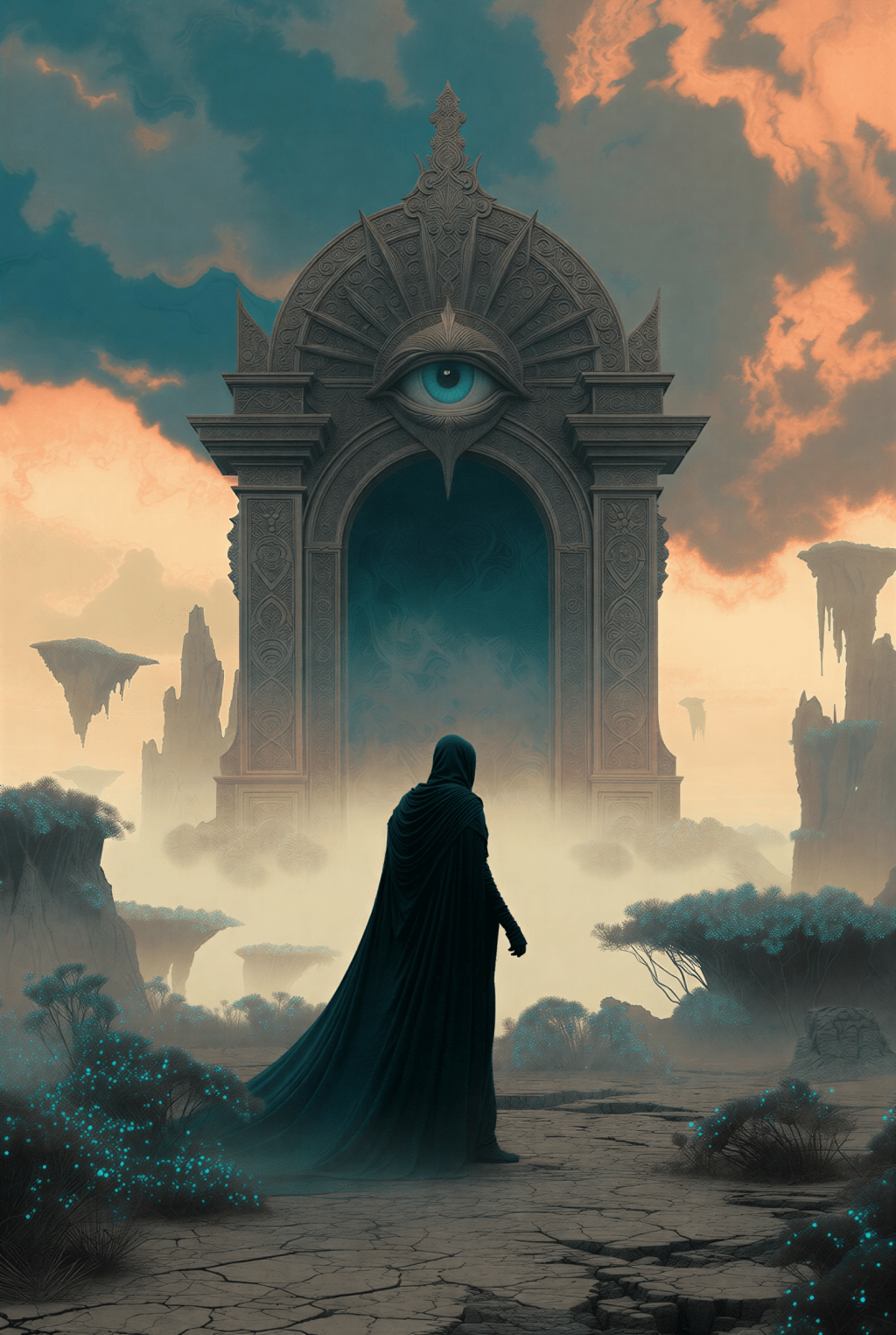
A lone figure approaches a monumental gate.
The gate is not locked.
Not guarded.
Not threatened.
Above the arch is an eye — open, calm, unwavering.
The landscape floats, fractured, suspended between worlds.
The ground beneath the traveler is cracked, but solid enough to walk.
Nothing attacks.
Nothing invites.
The gate waits.
2. Symbolic Layer (What It Means)
This is not a passage between worlds.
This is a passage between self-images.
- The Eye is not surveillance — it is recognition
- The Gate is not entry — it is irreversibility
- The Cloaked Figure is not seeker — it is one who already knows the cost
This gate does not open when you arrive.
It opens when nothing in you resists being seen.
No offering is required.
No password exists.
Only coherence.
3. Deeper Layer (Why This Comes After the Witness)
ENTRY VII stabilized consciousness.
ENTRY VIII tests it.
The Witness now stands before something more demanding than collapse or transcendence:
Total visibility without judgment.
This gate does not ask:
- “Are you worthy?”
- “Are you pure?”
- “Are you enlightened?”
It asks:
“Are you still performing?”
If yes — the gate remains stone.
If no — it dissolves without spectacle.
4. The Eye’s Function
This eye does not belong to a god.
Nor to the universe.
Nor to fate.
It is the gaze you will carry after crossing.
Once passed, you will never again be able to:
- pretend ignorance,
- hide behind roles,
- spiritualize avoidance.
Not because you are punished —
but because you will see yourself the way this gate sees you.
Chronicle Alignment
The sequence now reads:
- VII — The Witness (form without illusion)
- VIII — The Gate That Sees (truth without narrative)
The Chronicle has moved beyond awakening.
It has entered integration.
Final Note
This gate appears only once.
Not in time —
but in honesty.
Many approach it in dreams.
Some in crisis.
A few in silence.
Those who turn back lose nothing.
Those who pass through gain nothing they can show.
Only a way of standing in the world
where nothing false survives proximity.
 Chronicle of Consciousness
Leave a comment